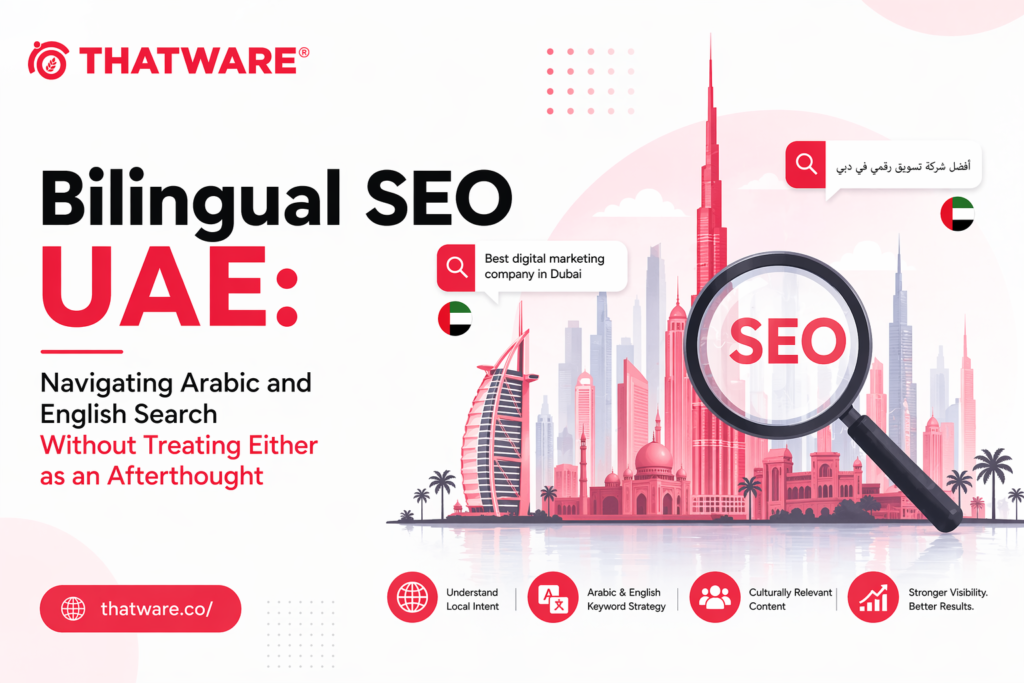
The UAE presents one of the more genuinely interesting bilingual SEO challenges in the world – and also one of the most commonly mishandled. The country has a population that’s predominantly expatriate, a significant Arabic-speaking Emirati and Arab resident base, and a business environment where English functions as the primary language of commerce and professional services. Both languages matter for search. They serve different audiences with different search behaviors. And the mistake most brands make is treating one as primary and the other as the afterthought.
You can tell which language got the afterthought treatment pretty quickly on most UAE business websites. Either the Arabic version is a thin, mechanically translated shadow of the English content, or the English version is clearly the native product and the Arabic exists to technically comply with some local requirement. Neither approach serves the audience that language is meant to reach. And search performance in that language reflects it.
The UAE Search Landscape Is Genuinely Dual
Most markets with two official or significant languages still have a clear primary language for search – Canada leans English-dominant in most categories outside Quebec, Switzerland varies strongly by region. The UAE is different. Google.ae search results serve both Arabic and English queries, and both have real volume and commercial intent across a surprisingly wide range of categories.
For B2C categories – retail, restaurants, services for residents – Arabic search volume is substantial because a significant portion of UAE residents prefer to search in Arabic. For B2B and professional services – consulting, technology, financial services – English tends to dominate because the business community conducts most professional interaction in English. For government-adjacent and public services, Arabic is often primary.
But these are tendencies, not rules. A healthcare clinic in Dubai might have substantial Arabic and English search volume for the same services, from different patient populations. A luxury retail brand might see English dominate among tourist and expat shoppers while Arabic serves a different resident audience. Understanding the actual language split for your specific category in the UAE requires actual keyword research in both languages, not assumptions based on general market knowledge.
Arabic SEO Is Not Just RTL Formatting and Translation
This is the misconception that undermines most UAE bilingual SEO efforts. Arabic-language SEO has specific characteristics that have nothing to do with text direction or translation quality.
Arabic search queries often use different keyword structures than the English equivalents. Modern Standard Arabic (MSA) and dialectal Arabic (Gulf dialect, Egyptian dialect, Levantine) are used differently in search – often within the same user population. A UAE audience might search for certain commercial terms in Gulf dialect and others in MSA, with patterns that require native linguistic knowledge to understand.
Arabic content needs to be written for Arabic readers, not translated for Arabic compliance. That means content that reflects Arabic rhetorical conventions, cultural references that resonate with an Arabic-speaking Gulf audience, and pricing and regulatory context appropriate to Arabic-speaking consumers – not just the English content with different words.
Google’s Arabic language understanding has improved significantly in recent years, which means that quality differences in Arabic content are more visible to the algorithm than they used to be. Thin, translated Arabic content that doesn’t reflect genuine engagement with the audience is increasingly likely to underperform regardless of technical implementation.
Seo agency uae partners doing bilingual SEO well in the UAE have native Arabic content capability – not translation services, but people who create Arabic content as primary producers, not translators.
Technical Bilingual Implementation
The technical implementation of a bilingual UAE site has specific considerations worth getting right.
Hreflang for Arabic and English requires careful regional coding. For UAE specifically, you’re typically targeting ar (Arabic) and en or en-ae (English / English for UAE). If you’re also targeting Saudi Arabia, Egypt, or other Arabic-speaking markets with the same or variant Arabic content, you’ll need country-specific regional hreflang attributes to avoid serving the wrong regional variant to the wrong audience.
URL structure for bilingual sites should be consistent and logical – subdirectories (/ar/ and /en/) typically work well for UAE bilingual sites and are easier to maintain than separate subdomains while preserving the domain authority benefits of a unified root domain.
Right-to-left (RTL) layout has SEO implications beyond just visual rendering. RTL content needs proper HTML direction attributes, correct font rendering (Arabic fonts that render clearly at all sizes), and navigation structures that work intuitively for RTL readers. Technical SEO audits of Arabic site sections should include RTL-specific rendering checks, as issues here create both UX problems and potential crawlability issues.
Page speed matters equally for both language versions. Arabic-language pages sometimes load slower due to heavier Arabic font files or improperly optimized RTL CSS – a technical issue worth specifically checking.
Local Authority Signals in the UAE Market
Building search authority in the UAE involves some market-specific factors that don’t apply in most other markets.
UAE government portals and official registries are credible citation sources that can reinforce local business legitimacy for UAE-targeted search. Being listed correctly on DED (Department of Economic Development) portals, trade association directories, and official business registries provides signals that Google uses to verify the legitimacy of locally-operating businesses.
Arabic-language media coverage from Gulf-based publications – including major regional titles like Gulf News, Khaleej Times, Arabian Business, and their Arabic-language counterparts – provides authoritative local link signals that are difficult to replicate through general international publications.
Professional seo services uae that understand the UAE market know which local publications and directories matter, both in English and Arabic, and build citation and link strategies around those specifically rather than applying global templates.
The Mobile-First Reality in the UAE
UAE internet usage is disproportionately mobile compared to most Western markets. Smartphone penetration is among the highest in the world, and a significant majority of searches happen on mobile devices. This isn’t a future consideration – it’s the current baseline.
The practical implication is that mobile UX quality for both the Arabic and English site versions needs to be genuinely excellent, not adequate. Slow mobile loading times, text that doesn’t render properly in Arabic on mobile browsers, navigation that doesn’t work well for RTL on small screens – these issues are more costly in the UAE market than in markets where desktop traffic shares are higher.
Core Web Vitals performance on mobile, specifically, is worth treating as a priority metric for UAE SEO regardless of how the desktop scores look. The audience you’re trying to reach is disproportionately on mobile, and search performance follows audience behavior.